



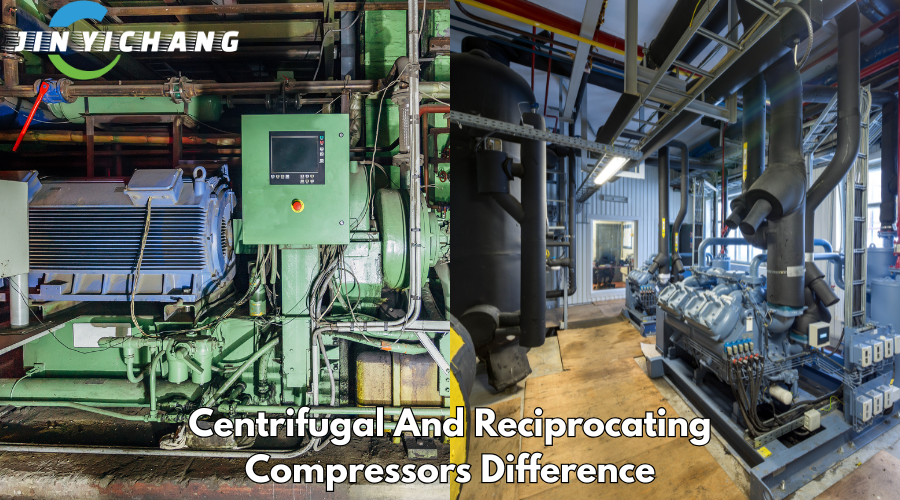
Compressors are machines that press air or gas into a smaller space. This makes the air denser and increases its pressure. We use compressors in daily life, such as in air conditioners and refrigerators. There are two main types of compressors: centrifugal and reciprocating. Each type works in a different way, and we can understand them by looking at how they operate and how they are different.
Take, for example, a bicycle pump. Pressing the handle down squeezes the air inside and expels it. This is true of a reciprocating compressor, except that it operates automatically via moving pipes that move back and forth in the cylinders.
The piston compresses and pulls in the air or gas through a plug-inlet valve. After that, it rises and pushes that air into less space, making it denser. When the pressure reaches a critical level, an outflow valve opens, releasing the compressed air. It is the same thing that happens again and again, like your heart in your living body pumping blood throughout your body.
Such compressors are referred to as reciprocating in that the movement performed by the pistons is back and forth. It is a simple idea that has existed for a long time, and it is really effective when applied to many situations.
The centrifugal compressors are totally different. They don't move air with pistons; they quickly push it with an impeller, a wheel. Suppose that there was a merry-go-round whirling. When you are sitting on it, you are gone. That is what happens to the air within a centrifugal compressor.
Air is drawn toward the center of the rotating impeller and expelled as the impeller rotates. The air becomes faster and more energetic as it rotates increasingly. Then it enters a diffuser, a specifically designed area that slows the air. Slowing of air in a limited area raises its pressure. This is how such compressors generate high-pressure air without pistons or back-and-forth motion.
The term centrifugal is the act of moving away, and this is what happens to the air within.
The primary distinction between these two kinds lies in their construction. The Reciprocating compressor contains numerous moving components, which move back and forth. All of these components coexist but cause friction and wear out over time.
Centrifugal compressors are far simpler in design. These are primarily the spinning impeller and housing. The decrease in the number of moving parts implies a reduction in friction and, often, in maintenance. Spinning motion is smooth and continuous as opposed to the termination and commencement motion of pistons.
Centrifugal compressors are the kings when it comes to the high amount of air or gas to be moved. They can handle large quantities of volumes since they do not stop spinning. Centrifugal compressors are commonly used in power plants, large factories, and large air-conditioning systems, as they must pump large volumes of air daily.
Reciprocating compressors are more convenient for lower volumes. They are well-suited for workshops, gas stations, construction sites, and minor industries. They may not transport as much air as centrifugal types; however, they are highly effective in their size.
This is where the reciprocating compressors come in. They are capable of producing at least very high pressures far more easily than centrifugal compressors are. Reciprocating compressors tend to be superior in scenarios where a very high level of compression is required, such as filling scuba diving tanks or specific industrial processes.
Centrifugal compressors may also generate high pressure, but typically have multiple stages to achieve it. At every step, an additional impeller gets attached, and the pressure is increased in stages.
Reciprocating compressors require more frequent maintenance. Every moving part that rubs against another requires lubrication. Valves may wear, piston rings may need to be changed, and seals may leak. They require routine maintenance to continue operating correctly.
Centrifugal compressors are relatively easy to maintain because they have few parts that come into contact with one another. The primary issue is balancing the impeller and ensuring that the bearings supporting the spinning shaft remain in good condition. They have the potential to operate at longer service intervals.
Each can be efficient, but it all depends on what you are doing with them. When centrifugal compressors operate at full capacity over an extended period, they are more efficient. They perform best when they can spin at any speed within the accurate speed range.
Reciprocating compressors are helpful when it is necessary to start and stop them or adjust pressure regularly. They are more effective for part-load operation than centrifugal pumps.
The choice between these two types depends on your needs. A reciprocating compressor is good for small workshops that need compressed air to run tools. It is low cost, takes up little space, and provides enough pressure.
Centrifugal compressors are better for large factories that need a steady and large amount of air. They cost more at first, but they are cheaper to run and maintain over time.
Both types are widely used in industry. Understanding how they work helps us see the engineering behind them and how they support modern life.